How can I obtain specific information about importing
and exporting wildlife, including obtaining CITES permits?
- Call our Import/Export office at the Anchorage International
Airport, at 907-271-6198. They can answer questions regarding
the restrictions and regulations governing the import/export
of wildlife and provide general information, and application
forms. The Import/Export Office is authorized to issue Convention
on International Trade in Endangered Species (CITES) permits
for the export of black bear, brown bear, wolf, lynx, and river
otter.
-
- The Office of Management Authority (OMA) issues CITES permits
for other species, and can be contacted at 1-800-358-2104. You
may also wish to the visit the Service's International Affairs
homepage.
-
What do I need to export wild game meat or trophies from
the state of Alaska?
- The State of Alaska requires an export tag for most big game
trophies. For specific information, you should contact the Alaska
Department of Fish and Game in Juneau at 907-465-2376, in Anchorage
at 907-267-2100, or any of their local offices. You may also
contact the Alaska State Troopers, Fish and Wildlife Protection
Division, through any state trooper post.
When exporting wildlife, Service regulations may require that
you file a "Declaration
of Import/Export of Wildlife" Form 3-177 at the time
of export. Depending on the species exported, permits may also
be required. Information concerning these requirements can be
obtained from the Import/Export office at Anchorage International
Airport. Their telephone is 907-271-6198.
- Can I import a polar bear that I killed legally in Canada?
- The Marine Mammal Protection Act (MMPA) allows the importation
of legally-taken polar bears from certain populations in Canada.
Applications for permits to
import sport-hunted polar bear trophies from Canada may be obtained
from the Service's Office of Management Authority 800-358-2104.
Because Anchorage is not a designated port of entry for wildlife
shipments, sport-hunted polar bear trophies may be cleared only
at designated ports in the lower 48 states, except for trophies
that are full mounts.
- Can I possess eagle feathers or other parts?
- Only Native Americans are allowed to possess eagle feathers
and parts for religious purposes, and a permit is required. You
can obtain an application for this permit in Alaska by calling
907-786-3459 or 907-786-3693. Eagle feathers or other parts are
distributed by the Service's Eagle Repository, located in Denver,
Colorado.
-
-
- Who in Alaska issues migratory bird permits?
- For permits involving activities regarding migratory birds
and eagles contact the Migratory Bird Office. Their telephone
number is 907-786-3459 or 907-786-3693.
-
Alaska is the largest and most sparsely populated U.S. state. It's known for its diverse terrain of open spaces, mountains, rivers and forests, with abundant wildlife and many small towns. It’s a destination for outdoor activities like skiing, mountain biking and kayaking. Massive Denali National Park is home to Denali (Mount McKinley), North America’s highest peak.
Capital: Juneau
Statehood granted: January 3, 1959
Population: 736,732 (2014)
State bird: Willow ptarmigan
Governor: Bill Walker
Size:
586,412 square miles
Access: Via air, sea, highway
Major Attractions: Denali (Mt. McKinley,)
the highest peak in North America; the Yukon River, third longest
river in the U.S.; thriving Alaska Native cultures; snow-capped
mountain ranges; 5,000 glaciers covering 100,000 square miles; 6,640
miles of coastline; and 70 active volcanoes.
Alaska's wildlife is as varied as the land itself, from bald
eagles, owls, hawks, falcons and thousands of migratory waterfowl
to Kodiak brown bears, polar bears, wolves, wolverines, moose,
caribou and 16 varieties of whales, including narwhals, with a
single tusk similar to the mythical unicorn.
Back in the 1960s, still recovering from the throes of the Good
Friday earthquake, the strongest recorded to date on the North
American continent, Alaskans often slapped on their motor vehicles
bumper stickers that read "We don't give a damn how they do it
outside." In the face of disaster, they had an attitude about
doing things with an Alaskan twist.
It was a time when most doors were not locked, when folks shopped
by catalog, grew vegetables in their gardens, and could hardly
walk down a street or board an airplane without recognizing half
the people they saw. Moose still roamed in downtown Anchorage,
where Walter J. Hickel, later governor of Alaska and Secretary
of the Interior, was building the Captain Cook Hotel, honoring
an earlier arrival with equal gusto for adventure. Newcomers to
Anchorage got a party line from the telephone utility and waited
for months to get a private telephone line, while in many isolated
rural communities there was one telephone , not always in working
order. Then in 1968, about 130 years after an agent for the Hudson's
Bay Company first reported oil seepages on the North Slope, geologists
for the Atlantic Richfield Co. found oil-soaked rocks at Prudhoe
Bay on the Arctic coast. The Prudhoe Bay discovery, culminating
with construction of an 800-mile pipeline from Prudhoe Bay to
Valdez, forever changed the state's destiny.
The hunt for oil, a modern-day gold rush, created a rush for
land, prompting Interior Secretary Stewart Udall to halt further
state land selections and federal oil and gas leasing until Alaska
Native land claims were settled.
The Alaska Native Claims Settlement Act of Dec. 18, 1971, laid
the groundwork for powerful Alaska Native regional and village
corporations, to whom the government agreed to return 40 million
acres and $1 billion for lands not returned. Many leaders of today's
diversified Alaska Native regional corporations, the sons and
daughters of subsistence hunters, are college educated and sending
their own children to some of the nation's finest universities.
Alaska today is still a land of extremes, with roots deep in
the past and space-age technology at work, from the dog mushers
who run more than 1,000 miles in the Iditarod Sled Dog Race from
Anchorage to Nome to rocket scientists at Kodiak and Poker Flats,
the latter a project of the University of Alaska at Fairbanks.
While archeologists dig at Kodiak Island to learn more about
the past, others use state-of-the-art technology to bring residents
better communications, transportation, health care and lifestyles.
Residents of rural villages that once had no phones now communicate
from home via phone, fax and electronic mail to points all over
the world.
Vanuatu is a 500-mile chain of islands lying between Fiji and Australia.
It ranges in topography from towering volcanic cones to dense rainforest to raised coral islands with wide beaches and deep, natural harbors.
The scenery is simply breathtaking.
Traditional island cultures, good beaches, and fabulous diving are the chief attractions of Vanuatu.
The climate is tropical humid with southeast trade winds keeping it ideal.
Average temperatures fall in the mid-70s to mid-80s F.
May to October is the best time to visit.
Vanuatu is a self-governing republic.
The most commonly spoken language is Bislama, in addition to English, French, and more than 115 "mother tongues."
Gewane is a small place between the Asab-road and the Awash-river, in the north east of Ethiopia.
Afar are nomadic people but Gewane Afar stay in their village most of the time because in the sixties large state-owned farms were created at the banks and in the swamps of the river and Gewane Afar don't have to search for water.
The young people are employed at the farms, which are privatised, and the elders are busy discussing local politics or family-affairs.

A local committee is formed to take care that the relations between the farm managers and the Afar goes smoothly. These committee members get a salary and this way they also benefit from the activities of the farmers. Although for 30 years this is their way of live, Afar still consider themselfs as free shepherds and owners of the soil on which onions are now growing.
Some Afar have sharpened their teeth, which is done with the knives they are carrying. All men carry a long stick, have a big knive and are dressed in mainly white. Women dress more colorfull.
Harar is home to 102 mosques and is considered a world heritage site by UNESCO
It was founded in the 12th century and in 1520 was captured by Ahmed Gragn (the left-handed) who from Harar invaded large parts of Ethiopia. In 1875 Harar was captured by the Egyptions and in 1887 by Menelik II who appointed Ras Makonnen, the father of Haile Selassie, as it's governor.
The former house of Haile Selassie can be visited and is momentarely used by a healer, who with herbs can cure you from a lot of diseases. The French poet Rimbaud has lived in Harar as a trader. Ask for the Rambo house and a guide will bring you to a beautiful mansion which is in restoration.
All around the walled city and in it are bigger and smaller markets among it the famous chat market.
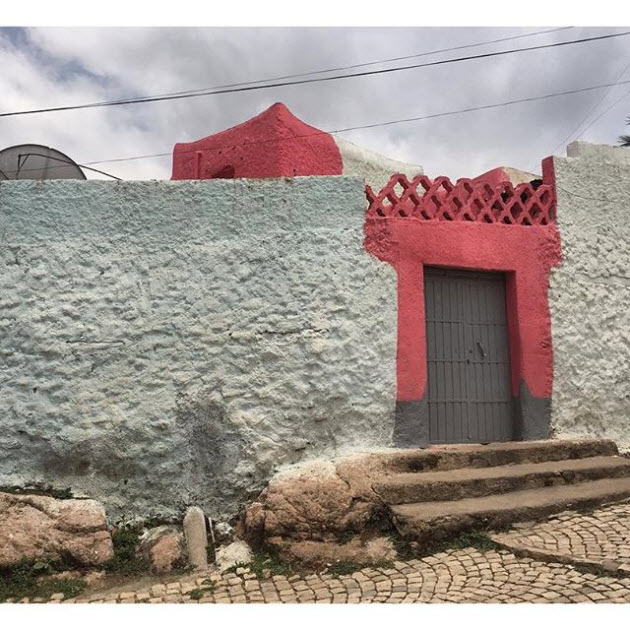
With a guide it's possible to visit some original Harari houses, which are beautiful painted and sculptured.
The Hyena man is considered as The tourist attraction of Harar, which in my opinion does no credit to the rest of the city. But for those who like to tremble and shudder, for a few dollars you can see men feeding the hyenas in the evening. Just ask your hotelmanager or guide to arrange it.
The beauty of Harar are it's colorfull people and it's unique atmosphere.
It's a pleasure to walk around the city, look at the people and bargain at the markets.
As a centre of commerce which it used to be, Harar feels like a place where people live and let live, a laizez faire mentality. At the same time it looks like a khasba which didn't change in it's centuries of existence.
St Mary's church was built a few yards away from
HaileSelassie's birth place in honor of the new born.
This site is found far in the country hills of Harar.
Only about 150 households are Ethiopian Orthodox and the remaining community is Muslim. The yellow flowers are called "Meskel Flowers".
Donkeys in the "Walled City" of Harar.
This city is entirely Muslim and is considered the third holiest land outside of Mecca.
Inside the town walls are markets lining the sides of the stone path. The people are selling everything from vegetables to herbs to fabrics and frankincense.
Fresh Lavender from the market in the "Walled City".
The locals use this plant in their vegetarian dishes. It smells sweeter than the herbs we have in the West.
Harari women in traditional dress, Eastern Ethiopia.
The Harari people, also called Geyusu, are an ethnic group inhabiting the Horn of Africa.
Members traditionally reside in the city of Harar, situated in the Harari Region of eastern Ethiopia.
Because of it's cultural legacy, UNESCO declared Harar, Ethiopia a "World Heritage Site".
To maintain this status, the people are not allowed to build any new buildings, so many families of different religions live together in the same house and have done so for hundreds of years.
This rare display of harmony also led to UNESCO awarding Harar the peace prize.
It's one of only a few of cities to receive both designations from UNESCO.
Harar is worthwile visiting. One of the many surprising faces of Ethiopia.
Great Salt Lake Utah Nature Reserve Location
40-42' n, 112- 113'W, within Davis, Box Elder, Tooele, Salt Lake, and Weber counties, Utah, United States.
Area:
The lake averages approximately 3,750 sq. km. (1,500 sq. miles) with fluctuations between 2,331 - 6,216 sq. km. (900-2400 sq. miles).
Description:
Great Salt Lake (GSL) is a closed basin saline lake located in Northwestern Utah, within the Great Basin. The lake varies in depth and voulme with climatic conditions. GSL is at an average elevation of approximately 4,200 feet above sea level and contains a range of salinities from 5 - 27 %.
Made part of a "three way twinning" with Laguna Mar Chiquita and Mono Lake in June, 1992 because of similarities in ecology and the fact that all three support large numbers of migrating Wilson's phalaropes.

Biology:
No accurate counts exist for most shorebirds using the Great Salt Lake. The few studies that have been conducted suggest that high numbers (perhaps millions) use the lake for breeding and migration. For some species, such as the Wilson's Phalarope, it is a major staging area. A one-day aerial survey in July, 1986 estimated 387,000 Wilson's Phalarope and 600,000 were estimated on a single day in July, 1991. Numbers of Red-necked Phalaropes, which seem more variable, have been estimated as high as 300,00+ on a single day. Recent ongoing studies suggest that at least 5- 10,000 Snowy Plover nest on the alkaline flats surrounding the lake. The current estimate for breeding American Avocet is 40,000 and Black-necked Stilts 30,000.
The following species have been recorded on the Great Salt Lake:
- American Avocet
- Baird's Sandpiper
- Black-bellied Plover
- Black-necked Stilt
- Buff-breasted Sandpiper
- Common Snipe
- Dunlin
- Greater Yellowlegs
- Hudsonian Godwit
- Killdeer
- Least Sandpiper
- Lesser Golden Plover
- Lesser Yellowlegs
- Long-billed Curlew
- Long-billed Dowitcher
- Marbled Godwit
- Pectoral Sandpiper
- Piping Plover
- Red Knot
- Red Phalarope
- Red-necked Phalarope
- Ruddy Turnstone
- Sanderling
- Semipalmated Plover
- Semipalmated Sandpiper
- Short-billed Dowitcher
- Snowy Plover
- Solitary Sandpiper
- Spotted Sandpiper
- Stilt Sandpiper
- Upland Sandpiper
- Western Sandpiper
- Whimbrel
- White-rumped Sandpiper
- Willet
- Wilson's Phalarope
Also recorded in the area are the Mountain Plover, Wandering Tattler, Hudsonian Godwit, Buff-breasted Sandpiper, Semipalmated Sandpiper, and Curlew Sandpiper.
The Great Salt Lake is also important to many other species. Hundreds of thousands of Eared Grebes stage on the lake, fattening on the abundant brine shrimp. One of the world's largest populations of White-faced Ibis nests in the marshes along the east side of the lake. The GSL hosts the largest number of breeding California Gulls, including the world's largest recorded single colony. Approximately 150,00 breeding adults have been documented in recent years. The American White Pelican colony on Gunnison Island ranks in the top three in North America. up to 17,000 breeding adults have been recorded. Numerous other species depend upon the lake, such as Franklin's gulls, waterfowl, herons, egrets, terns, raptors (including Bald Eagles and Peregrine Falcons), and songbirds.
Land Use:
Recreation and tourism, mineral extraction, sport hunting, brine shrimp harvesting, and lake side coil and copper refineries.
Threats:
Development of Southern and Eastern shores, primarily industrial, urban, agricultural, recreational and tourism threaten the lake. Plans for a major highway connecting Salt Lake and Davis Counties, that would bisect many GSL wetlands is also a threat, as is the possibility of using the lake as a dumping site for contaminated soil (arsenic and lead) from a super fund site. Attempts to stabilize water level and salinity could severely threaten the Lake's ecology. This is due to poor understanding of the Lake's ecosystem and the effects of alterations, especially to the Lake's saline component and connected organisms such as brine shrimp, brine flies and to a large degree, many shorebirds.
Ownership:
The lake is primarily owned by the State of Utah, with large blocks of land falling under the management of the State Department of Natural Resources and U.S. Fish and Wildlife Service. Above the meander line (4202-4215ft.), ownership is largely private, with some Nature Conservancy land and many privately-owned duck clubs.
Effective Protection:
Parts of the Lake are included in USFWS and State refuges as well as Nature Conservancy Lands.
Management and Research Activities:
In the mid-1980's, all of Bear river Migratory Bird Refuge was inundated by the Great Salt Lake and the refuge was Closed. The flood waters have receded and the refuge was restaffed in 1989. An Environmental Assessment on the restoration and expansion of the refuge was finalized in 1991. Refuge objectives highlight shorebird management and as restoration continues, shorebird use will be enhanced.
A concept plan for an Intermountain West Joint Venture, under the North American Waterfowl Management Plan, is nearing completion. The Great Salt Lake and shorebirds are highlighted in the plan. Implementation of the joint venture will lead to partnerships that will protect and enhance shorebird habitat.
The Utah Division of Wildlife Resources is conducting several studies designed to determine the extent of shorebird usage at selected sites around the Great Salt Lake. An annual survey of migrating Wilson's Phalaropes using the lake each year is being conducted by UDWR personnel under a contract with Hubbs Sea World. A study of temporal and spatial distribution of shorebirds is being conducted by the Utah Cooperative Fish and Wildlife Research Unit, and is jointly funded by the Utah Division of Wildlife Resources (UDWR) and Region 6 of the U.S. Fish and Wildlife Service ( Regional nongame migratory bird and North American Waterfowl Management Plan (NAWMP) funds. A study to determine the nesting and foraging habitat requirements of the Western Snowy Plover around the lake is being undertaken by the Cooperative Research Unit and funded by the UDWR. Twice a year, several volunteers participate in the PRBO Pacific Flyway Project survey on the Great Salt Lake.
The UDWR, with help from the Fish and Wildlife Service, is currently working to identifying lands important, or potentially important to the management of shorebirds around GSL.
Kavos is a small town in Corfy, Greece, "The Emerald Isle" or it is known as "The Greek Ibiza."

Airport
If you are going to Kavos during June - August, I would advise to wear a comfortable T-Shirt before you get on your flight from the UK. Ok, people will might think you're a bit weird for getting on the flight with a thin T-Shirt and shorts/skirt especially if it's freezing outside, but as soon as you get off the plane at Corfu Airport the heat hits you. All the people getting on the flight with Eskimo clothes on will wish they had done the same. Especially waiting for their suitcases. Trust me Corfu airport is one hot annoying place. I know this from experience. Some people wear big coats, crazy!! Remember you are going to the med not Manchester. Your bodies natural central heating system still thinks your in England so you tend to sweat naturally.
Alcohol.
In Kavos booze is very cheap, the cheapest decent bottle of beer is AMSTEL 500ml, this costs around 0.65 Euro which is around 40p in English. Be aware that you can buy booze during the day and before you go at night from the supermarket, you can buy crates of beer at a cut down price. Also with most supermarkets and shops, if you bring the crate back with the empty bottles intact they give you some of your money back, this is around 3-4.5 Euros (2-3 quid). Ok its not much but put it this way 4.5 Euros is a couple of drinks. Amstel collect the bottles and reuse them. So keep that in mind instead of lobbing the empty bottles off the balcony or in the bin.
As for bottles of any other label I am unsure about the price, remember that any bottles you buy in the UK are brewed in the UK. Most of the labels bottles e.g. W.K.D, Barcardi Breezer, Hooch & UK popular labels have to be imported from mainland Greece so you will be expected to pay that extra. Some supermarkets are open late night in Kavos, so if you're gagging for a beer buy its cheaper to buy from the shop than the bars and clubs, and a lot quicker to get served.
Good UK beers on tap are quite rare in Kavos, because the importation costs are high.....however the Scorers Bar do Boddingtons and Caffreys on tap also the Face bar, expect to pay around £3 pint though.
What is a good idea is to buy lots of crates and get hammered on your balcony before you go out. Make sure you give the beers a few hours in the fridge, because warm beer/bottles will give you a nasty stomach ache. The heat out there is HOT!, so prepared to wait a while for them to cool down. Some supermarkets don't refrigerate their bottles, this is because they are in crates, so get the booze in a few hours before you go out. As for wine, I never looked at the price, though I'm sure its very cheap. All med wines are cheap and popular.
Always keep topped up with bottled water in your apartment, because you don't want to come back to your apartment totally smashed to realise that you're going die of thirst during the night/early morning. NEVER drink the tap water, no matter how thirsty you are, some guy last year caught legionaries disease through drinking the med tap water. This is the most extreme case, but most of the time you are at risk of getting the sh**ts or becoming ill for a few days. So remember it's worth going back out to find a bar that sells bottled water (all bars do). Bottled water in Kavos from the supermarkets is ridiculously CHEAP, so stock up with lots.
Food.
If you are going to Kavos self-catered (which most people do) then you can eat out very cheap. For a full English breakfast you can pay around £1.40 - £3.20, that includes full English breakfast with a drink. Their are a few good restaurants in Kavos that do good breakfasts, however an English Breakfast abroad never tastes anywhere near as good as home in the UK. It's easier to eat out rather than stock up your own grub for the morning, however in the afternoon I tended to go to the supermarket and buy food to take back to my apartment to cook up.
If you want some grub coming back from your Kavos raving beware of what you purchase from the takeaways, Kebabs are dodgy in the UK, so at a holiday resort they are going be far more dodgy, you don't want to have food poisoning like I did for two days. Just be careful and see if the meat is cooked properly, because the takeaways are going to be hammering the food out if their is a big queue and some of it isn't going be cooked 100% just the same as the UK. Don't let this put you off, their are some very good takeouts in Kavos...just be aware.
Money
I can't advise anyone on how much to take to Kavos, it depends if you are a big spender, a small spender or a stupid spender. On average £600-£700 should do you a good time for 2 weeks if you don't go stupid. However £600-£800 should see you a mint time if you've got the cash. I personally would take 50% of my cash in Travellers cheques (don't knock them), you can get then exchanged off your local exchange easily and at least you are insured if you lose them or have them stolen. Remember nobody keeps found travellers cheques that somebody has lost, but they will keep money. You will be able to keep your passport safe in a deposit box if you wish (your rep should mention this), this is much safer than keeping it in your apartment. In the extremely unlikely case of a robbery while you are gone you don't want your passport stolen, also your money 'so' consider Travellers cheques. Get your cash exchanged at Thomas Cook for the best deal.
Mopeds (scooters)
I think all the guys know that when they get to Kavos they want hire the mopeds. These guidelines are for more the lads than the women, seen as though the women are much more sensible with them. Right ok here is the low down, most of the accidents that happen in Kavos are motorbike related (just thought we would mention that). You can loan a scooter for as little as £8 a day, that is 9-5 PM, however if you pay for what you get...if you are willing to pay £12 - £15+ squid then you will get a higher cc engine. If you have not ridden a motorbike before then hire the lowest cc to get use to it and a more powerful one the next day when you are much more confident. If you go for the powerful bike first with no experience, you will most certainly come off it sooner or later. You can hire the crosser bike that has gears and a clutch, they are one of the fastest but also the more dangerous and noisy. Beware that if you crash the bike you will have to pay for the damage, when you loan a bike they take your passport so you will have to bring it back if you have crashed one in a ditch. I knew one guy who had crashed 2 bikes in a day, it added up to around £500 quid in fines. If you're prepared to take that chance and go wild on a bike, remember the consequences that if you crash you will receive a free broken neck and bike repair cost. Before you loan the bike check the brakes are working correctly and the steering. If you don't and your brakes are nakered, it will be too late to realise when you are driving down a road and you realise your brakes a mashed just before you hit the back of a car...game over.
Other than that the bikes are amazing and you can view Corfu to its full beauty rather than stay in Kavos. Go down some of the Corfu outback to have a heck of a bike ride.
Dodgy Del Boys & Flower sellers.
Beware of the Gypsy Del Boys and Rose Flower sellers who walk the streets of Kavos trying to flog you gear such as laser pens that don't work and glow in the dark sticks. If you are prepared to buy something off them always haggle, you can knock them down to peanuts. This also works with the roses they sell, always haggle. Beware of the little scroats that walk with them, most probably their kids...that can pick pocket in bars and street when it's hammered. *NEVER! let them hold your wallet or purse to let them pick out how much they want to charge you.* Also never hand the little scroats your wallet or purse because they will just run off with it.
Dodgy designer labels.
Kavos shops are flooded with fake Ralph Loren and DKNY gear such as caps, belts and tops. Well I can't knock some of the gear because the fakes are very good ones, I bought a DKNY cap for £4 quid which is a exactly the same as the original for £40. You cannot tell the difference. As for the clothes I don't know, I wouldn't chance it incase they fade in or dye in the wash. But from the looks of them they are very good fakes. By far better than UK fakes.
Sunburn
I don't need to tell you how hot it is in Corfu, If you are pale skinned when you go over, through lack of UK sun go for a factor 15 and no less for the first few days. Always remember to put it on as well, because if you go out in the sun for more than 30 minutes without it you will most certainly peel and burn which will ruin the rest of the holiday (sunstroke even). Don' worry about taking lots of lotion as well, the shops in Kavos sell good labels.
Mosquito Repellant
Personally nothing works fully to keep mosquito's out of your room, whether they be plugs, repellant or the mosquito candles. These just keep them at bay. You can only prevent yourself from being eaten alive. Everyone seems to go for the plugs which are quite effective...though the plug I used last year was pants, the mosquito's were sat on it laughing, saying 'is this all ya got mate!'. I would personally go for the plug and after sun repellent lotion. Some people don't get bitten once while they are on holiday, mosquito's go for a blood type..so you may not even get touched whilst in Kavos...on the other hand you might be a 4 course meal so always take the plugs just incase, I think Superdrug do one for a around £5 with a good supply of repellent tabs for 2 weeks. If you have one from a past holiday, you can by the tabs from the supermarkets for around 0.6 Euros (40 pence) a box. The Corfu tabs are a lot more affective than the ones sold in the UK.
Taxi's
Before you set off in a Taxi, always sort of out the charge before hand. Remember haggle! haggle! haggle!. You will always get your price down from what he charges.
Never try and take some substances over with you, trust me. At the end of the day it's not worth having a criminal record and being ring raided over a few pills.